A spark arrestor is a mesh screen fitted over the flue outlet that stops embers from escaping and blocks animals from entering. The Chimney Safety Institute of America (CSIA) and NFPA 211 both reference spark arrestor…
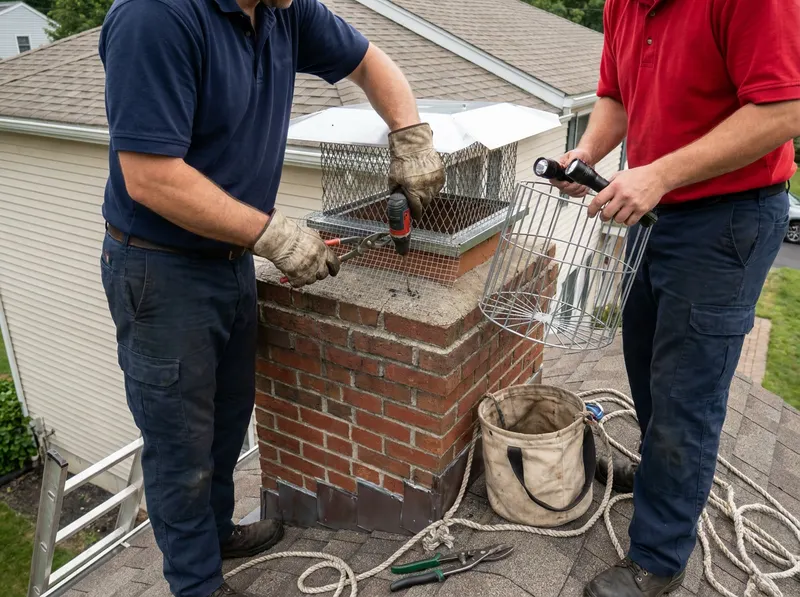
A spark arrestor is a mesh screen fitted over the flue outlet that stops embers from escaping and blocks animals from entering. The Chimney Safety Institute of America (CSIA) and NFPA 211 both reference spark arrestor screening with openings no larger than 1/2 inch, small enough to keep out squirrels and birds but large enough to pass exhaust. A custom guard in 316 stainless mesh resists coastal salt corrosion better than aluminum or galvanized steel, which matters for shoreline homes in Woodmont, Walnut Beach, Point Beach, and Laurel Beach where salt air shortens the life of cheaper caps.
Animal entry in Milford follows a seasonal pattern. Chimney swifts and other birds nest in unlined or open flues between April and August, and chirping without an exit usually means a nest sits low in the flue. Raccoons den in wider masonry flues from late winter through spring to raise young; a raccoon inside a chimney generally requires removal of the animal first, because sealing a flue with a live litter inside is prohibited under Connecticut wildlife rules. Older uncapped chimneys in Morningside, Rivercliff, and the Devon streets near Milford Harbor are the most common candidates because decades of missing caps leave the flue fully open.
Deciding what fits the situation is straightforward. If the flue is currently open and no animal is present, a single-flue 316 stainless mesh animal spark arrestor is the direct fix and prevents future entry. If an animal or nest is already inside, the sequence is: 1) confirm what is in the flue with a Level 1 or Level 2 inspection, 2) remove the nest or the animal, 3) clean out the chimney of remaining debris and droppings, and 4) install the guard so the problem does not recur. A stock crown-mounted cap suits standard round or square terracotta tiles; a custom-fabricated guard suits irregular crowns, oversized openings, or multi-flue stacks where a single cover must span more than one liner. The trade-off is cost against fit, a stock cap is cheaper but seals only a matching opening, while a custom guard costs more and sits flush on non-standard crowns common in older Fort Trumbull Beach and Bayview Beach masonry.
After removal, cleaning out the chimney is not optional when droppings, feathers, or nesting material remain, because bird droppings can carry histoplasma spores and dry nest debris is flammable near the flue liner. A free on-site estimate confirms flue size, guard type, and whether a Level 2 inspection is warranted before pricing the guard. Homeowners in Gulf Beach and along the shore comparing options can get some quotes on both stock and custom guards during the same visit.
Every job gets a firm, written price after a free on-site visit.
Tell us about your animal removal & spark arrestor job in Milford and we'll send a clear, written quote, usually the same day.
 Fluepro Chimney Sweep