Chimney repair splits into two very different jobs, and knowing which one a chimney needs prevents paying for the wrong fix. Mortar chimney repair addresses the visible masonry, worn joints, spalled brick, and a…
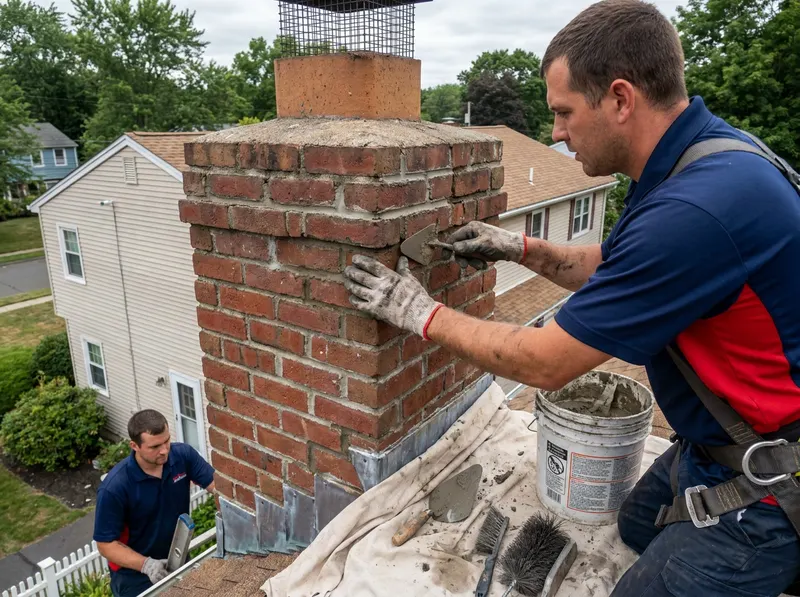
Chimney repair splits into two very different jobs, and knowing which one a chimney needs prevents paying for the wrong fix. Mortar chimney repair addresses the visible masonry, worn joints, spalled brick, and a cracked crown. Along the shoreline in Devon, Woodmont, and Walnut Beach, salt air and wind-driven rain erode mortar joints faster than on inland stacks, which is why coastal chimneys often need repointing every 15, 25 years rather than the 25, 30 typical elsewhere. Tuckpointing grinds out the failed joint to about 3/4 inch and packs new mortar to match the original mix, restoring the weather seal.
Repair of the wood structure of a chimney is a separate problem hidden behind that masonry. On many Milford homes, a factory-built or framed chase carries the flue, and the wood underneath the mortar or siding can rot when flashing fails or a crown cracks and lets water track down. A chimney that looks sound from the street might have some wood rot in the framing, the chase top, or the roof decking around the base. Wood structure chimney repair means opening the chase, removing the soft or delaminated framing, and rebuilding it in dimensional lumber before the mortar or siding goes back. Water intrusion in older homes near Point Beach, Bayview Beach, and Laurel Beach commonly shows first as ceiling stains or a musty smell near the firebox, signs the framing, not the brick, is the source.
The decision path is straightforward. If the damage is limited to loose joints or a hairline crown crack with no interior water sign, mortar repair alone restores the chimney. If an inspection finds soft framing, stained sheathing, or a chase top that flexes underfoot, the wood structure must be rebuilt first, repointing over rotted wood traps the moisture and the mortar fails again within a season. A CSIA Level 1 inspection covers readily accessible portions; a Level 2 inspection, required by NFPA 211 after a system change, property sale, or a chimney fire, uses a camera to check the flue and concealed framing where rot hides. Homes in Morningside, Rivercliff, Fort Trumbull Beach, and Gulf Beach with original wood chases are the most common candidates for a Level 2 look.
Factory-built fireplaces are a third category. Lennox fireplaces and similar prefabricated units are repaired by replacing manufacturer-specified parts, refractory panels, glass doors, blowers, and gaskets, rather than rebuilding masonry. A cracked refractory panel or a warped damper on a Lennox unit is a parts-and-labor repair, not a tuckpointing job, and the correct model number determines the parts. Every estimate begins with a free on-site visit so the actual condition, masonry, wood, or firebox, is confirmed before any range becomes a quote. Workers are bonded and insured. Phone: (475) 387-3943.
Every job gets a firm, written price after a free on-site visit.
Tell us about your chimney repair job in Milford and we'll send a clear, written quote, usually the same day.
 Fluepro Chimney Sweep